The digital age has brought incredible advancements, especially in healthcare. AI and digital health for longevity are revolutionizing disease prevention, treatment, and overall well-being. From early diagnosis to personalized medicine, AI-driven tools are reshaping how we approach health. But the key question remains: Can these innovations truly extend human lifespan and improve quality of life?
Experts explore how AI-powered machines are reshaping the future of healthcare, from disease prevention to personalized treatment. With the integration of AI, machine learning, and predictive analytics, healthcare systems are evolving to identify health risks early and provide tailored treatments. These innovations have the potential to transform longevity, improving both the length and quality of life.

At the epicenter of digital health, a scientist is utilizing the highly advanced infrastructure of Artificial Intelligence to analyze large volumes of data, accelerating crucial scientific research to improve human longevity and quality of life. She wears blue gloves and lab goggles, holding a smartphone in her right hand, most likely listening to someone speaking to her or waiting for the call to be activated. She occupies a prominent position at the center of the image. Behind her, another scientist, also wearing blue gloves, operates ultra-modern equipment, including Big Data tools, AI, and highly sophisticated devices designed for processing next-generation data. All of this is aimed at maximizing human longevity through these excellent technological innovations in a very high-tech digital health research center. The surrounding environment is filled with state-of-the-art technology, representing a very innovative research center dedicated to digital health and transforming healthcare. These advances are enabling rapid and highly impactful scientific discoveries, set to significantly improve human quality of life and drastically increase human lifespan in a continuous and growing manner across the globe.
AI and Digital Health: Transforming Healthcare Today
Artificial intelligence is no longer just science fiction; it is revolutionizing healthcare. Unlike humans, who rely on experience, AI processes vast amounts of data instantly, making it invaluable for diagnosing diseases, analyzing medical records, and offering personalized treatment recommendations.
One of its greatest strengths is detecting patterns that might go unnoticed by doctors, such as early signs of cancer. These advancements not only enable earlier diagnoses but also improve treatment options and patient outcomes.
AI and Digital Health: Revolutionizing Early Diagnosis
AI has given rise to one of the greatest advances made in healthcare diagnosing diseases at the earliest possible stage, sometimes even before they become symptomatic. In radiology, for example, the A.I. algorithms can take in medical images, picking up on subtle gradients that could indicate diseases like cancer, occasionally catching it before follow-up human examinations.
Early diagnosis is important because it allows patients to begin treatment before any symptoms become more serious, which contributes to better long-term survival and health outcomes for the patient.
AI and Digital Health: Unlocking the Power of Genetics
In the past, doctors used broad treatment protocols, administering the same therapies to patients with similar conditions. Now, AI is driving a shift toward personalized treatment protocols by analyzing genetics, lifestyle, and medical history.
This is especially promising in oncology, where a life-saving treatment for one patient may not work for another. By customizing therapies, AI significantly improves treatment effectiveness, enhances long-term outcomes, and helps prolong lives.

Scientists working in a highly modern, very well-equipped laboratory featuring a robot, some taking notes, focused on AI and digital health technologies, with a stunning view of Beijing, China.
Health Forecast: Prevention Is Better than Cure
AI is not solely diagnostic; it is prognostic. The technology spots risk factors and predicts potential health issues before they emerge by analyzing past medical data. For example, A.I. can examine a patient’s health history to forecast the likelihood of chronic diseases like heart disease or diabetes.
These predictions give patients time to make preventative lifestyle changes—altering their diet, beginning a fitness regimen, or possibly initiating a pharmaceutical intervention. Predictive analytics applied to health can prevent disease from being established, resulting in extended health and longevity.
Harnessing Technology for Aging Insights
Aging is a natural process, but can technology actually slow it down? AI is emerging as a powerful tool in aging research, helping scientists analyze vast genetic and clinical trial datasets to uncover the biological mechanisms behind aging and age-related diseases. Its potential lies in identifying key factors that drive aging, paving the way for breakthroughs that could extend human life while preserving a high quality of life.
AI and Digital Health: How Wearable Tech Enhances Self-Care
Smartwatches and fitness trackers are more accessible than ever. These wearable devices collect real-time data on various aspects of users’ health—such as heart rate, sleep quality, and activity levels.
AI-powered wearables also provide personalized feedback. They can alert users to potential health concerns if the collected data suggests something is wrong. For example, the device might recommend going to the hospital if it detects a sudden spike in heart rate.
And wearables aren’t just for tracking general wellness. Increasingly, they’re used to monitor chronic conditions like diabetes and hypertension. This allows patients to better manage their health and take preventive steps—supporting longer, healthier lives with greater independence.
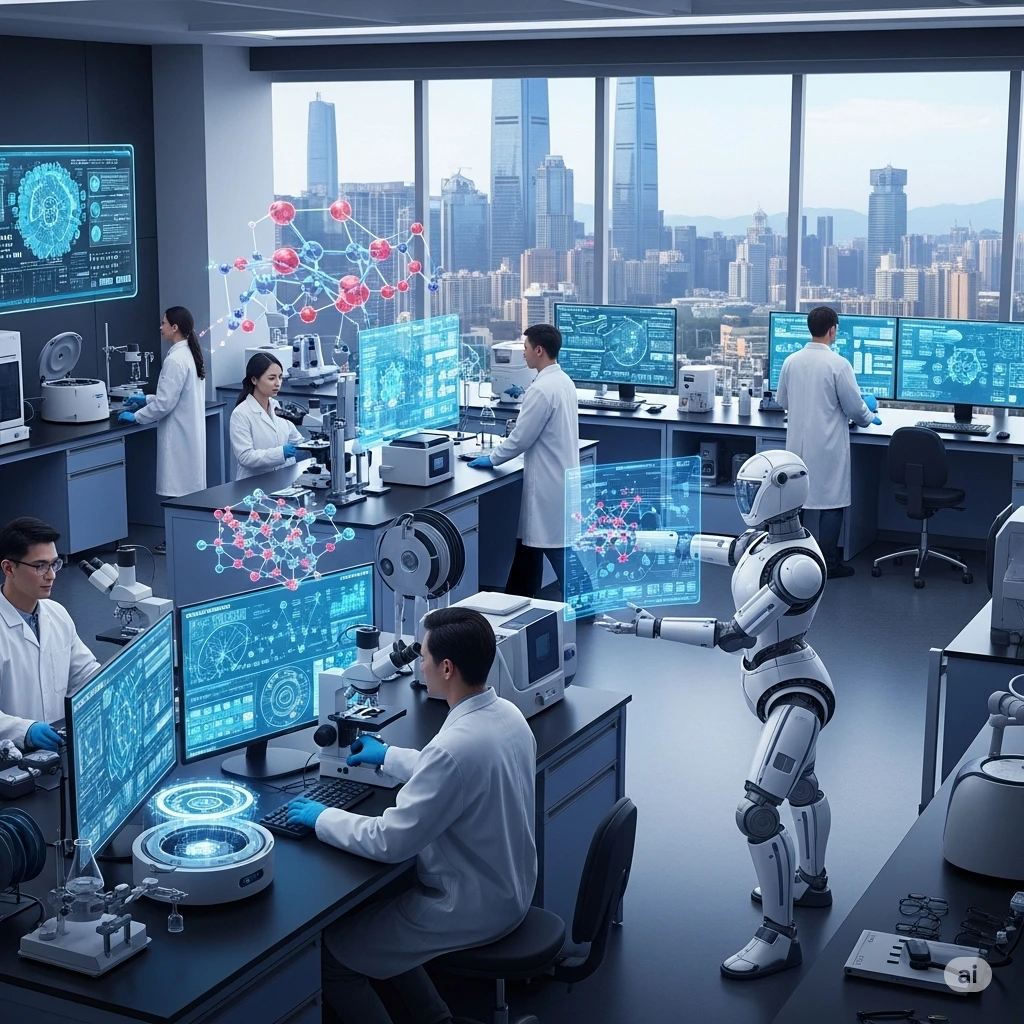
Scientists collaborating in a cutting-edge, fully equipped laboratory in Shenzhen, China, utilizing holograms and robotic technology for research on artificial intelligence and digital health, overlooking a breathtaking urban skyline.
AI and Digital Health: The Role of Technology in Mental Well-Being
Mental well-being is just as vital as physical health when aiming for a long and fulfilling life. Stress, anxiety, and depression don’t just affect mood—they can take a serious toll on the body, increasing the risk of heart disease, weakened immunity, and other health issues.
AI-driven platforms are stepping in to reshape how we approach mental health. From tracking emotional fluctuations to recognizing early warning signs of distress, these tools provide personalized recommendations—whether it’s relaxation techniques, therapy suggestions, or even real-time interventions.
But AI’s role goes beyond just day-to-day support. Researchers are using machine learning to decode brain scans, analyze genetic markers, and dive deeper into psychological patterns. These insights could revolutionize treatments, making mental health care more effective and tailored to individual needs.
As technology advances, so does our ability to foster emotional resilience—bringing balance between mind and body and, ultimately, extending the quality and length of life.
Ethical Issues and Hurdles
For all the contributions of AI and technology to healthcare, it is not devoid of a multitude of ethical considerations and challenges. A big problem is privacy — AI requires an enormous amount of personal health data, raising questions around data security, storage and consent. This is a fine line to walk and must be allowed and regulated, striking a balance between utilizing this data to allow better healthcare, the cost of which is in the protection of patient privacy.
AI systems raise another concern: reliability. AI algorithms are only as good as the data they’re trained on, and errors in data or biases in the algorithms can drive incorrect diagnoses or treatment recommendations. When AI systems are doing things that can result in life or death outcomes, getting it right is, by definition, a matter of life and death, so having accurate and defensible systems in place is someone’s No. 1 priority.
Finally, AI-enabled healthcare is not available to everyone. People in underserved communities or lower-income neighborhoods may not have access to the latest technology or health care advances. Such inequality may deepen disparities in the availability of health services, and as a result, the benefits of these technologies might not reach every sector of society equally.

Scientists and robots working in a highly advanced, fully equipped laboratory, reflecting the challenges and progress in integrating AI and robotics into very modern scientific research.
Conclusion
It is the age of digital invasion, which will disrupt various industries, and when we talk about the healthcare industry, no other is used to build such complex decisions for improving health and human longevity. From early disease diagnosis and personalized disease management to predictive analytics and advancements in age-related research, technology has tremendous potential to not just help us live longer, but to help us live better as well.
But with these advancements come challenges. To ensure that these benefits are widely felt, privacy and accuracy concerns, as well as inequities in technology access, must be addressed. If used wisely, AI and tech may multiply longevity in the right spirit, help ensure we live long, and help ensure we live well.
But the search for the key to a long life is only just beginning, as we enter the new world of health care enabled by the digital age. With the right tools and responsible technology usage, the future of healthcare is looking very much in sync.